1. Fanjiatai Prison in Shayang City Uses Slave
Labor to Assemble Christmas Lights for Export to the U.S.
http://www.clearwisdom.net/emh/articles/2004/5/8/47833.html
2. Slave Labor and Disguised Extortion in Detention Centers in Wubei, Hubei Province
http://www.clearwisdom.net/emh/articles/2004/5/4/47705.html
3. Falun Gong Practitioners Jailed in Changsha City, Hunan Province, Forced to Do Slave Labor
http://www.clearwisdom.net/emh/articles/2004/7/8/50007.html
4. Items Produced by Slave Labor in Chinese Labor Camps Appear on Renowned Italian Brand-Name Website (Photos)
http://www.clearwisdom.net/emh/articles/2004/6/28/49611.html
1. Fanjiatai Prison in Shayang City Uses Slave Labor to Assemble Christmas Lights for Export to the U.S.
By a practitioner in Hubei Province, China
(Clearwisdom.net) Fanjiatai Prison in Shayang City, Hubei Province, forces the prisoners to work long hours under slave labor conditions, assembling products for export. This prison has many contracts with companies in the provinces of Zhejiang, Jiangsu and Fujian. It has been learned that many products manufactured in Fanjiatai Prison are regularly destined for export to western countries.
An example of these kinds of export products are strings of colored Christmas lights. There are several styles and colors of the Christmas light products, normally used for decorating a Christmas tree, a window or the exterior of a house. Each string of lights may be installed with 150, 200 or 300 tiny, colored bulbs. A string of fifty 2.5-volt bulbs, for example, is designed to require a 110-volt electrical outlet, which is the same voltage used in the U.S.
Some of the products assembled at Fanjiatai Prison are also transported to Zhejiang Province, where they are assembled for bulk shipment to Taiwan, because these products are to be exported to the U.S. by Taiwanese businesses only. The Christmas lights assembled at Fanjiatai Prison are among the most popular type purchased in the U.S. Falun Dafa practitioners formerly held in this prison have some samples of these tiny lights in their possession, as proof of their allegations. [Note: it is against U.S. law to import any product, of which any part was manufactured or assembled using penal or forced labor.]
Postal code of Fanjiatai Prison, Shayang City, Hubei Province: 448200.
Phone number of Fanjiatai Prison's "Re-Education" Department: 0724-8575505.
Chinese version available at http://www.minghui.org/mh/articles/2004/4/18/72604.html
2. Slave Labor and Disguised Extortion in Detention Centers in Wubei, Hubei Province
By a Hubei Dafa practitioner
(Clearwisdom.net) Detention center guards in Wuhan, Hubei Province force detainees to do slave labor in their prison cells. For example, in Xiangfan City No. 1 Detention Center, they force the detainees in their cells to produce medicine boxes, and to assemble elementary and preschool textbooks. The criminals, including drug addicts, robbers, murderers, ruffians, and people who have committed all sorts of crimes and are of low moral character, do unbelievable things during this process. For instance, when they produce the medicine boxes and fit the books together, these criminals purposely wipe filthy things onto the products, such as excretions from rotting wounds on their feet, blood, pus, and other filth. The detention center officials do not bother to do anything about this.
The detention center enforcers also collect tainted money. Not only do the slave laborers not get a single cent; but on top of that, some detainees are forced to pay 20 Yuan in "accommodation and meals fees" for each day they are locked up. Family members are not permitted to help the detainees with daily necessities such as a washbasin, toilet paper, or slippers (once they enter the detention center they have to throw away their shoes and bare their feet). Family members must send money, the only thing the detention centers will accept! The detention center controls the money - the detainee only gets a piece of paper as proof of such-and-such a cash balance "deposited" with the detention centers. The daily necessities are bought and sold at the detention centers' stores at a price set by the detention centers. They buy the poorest quality goods for the detainees, yet deduct cash that is two to three times the original cost. For example, for a bar of soap and a pack of toilet paper, the cost is less than 1 Yuan, but they deduct 2.5 Yuan. A box of instant noodles costing 10 Yuan is sold for 40 Yuan. It costs the detainee 100 Yuan for the prison doctor to ask, "Are you sick or not?" without the detainee actually undergoing any kind of examination. Disinfecting of the prison cells is carried out in the summer. Each cell is charged 10 Yuan for one disinfecting. The detention center officials deduct at will from the detainees' cash balances and then reduce the cash balance in the bookkeeping records. This is obviously a disguised form of extortion.
The policemen in the detention centers verbally and physically abuse Dafa practitioners. It is also common practice for the common criminals to verbally and physically abuse the practitioners. Many Dafa practitioners suffer severe persecution and inhuman torture. For example, they are punished by being forced to stand against the corner of the wall, being heavily fist-punched in the heart by criminals, being slapped, being forced to maintain a half-squatting position (squatting down with legs apart and both arms raised forward, parallel to the ground), and having cold water poured on them during winter time. If Dafa practitioners do the Falun Gong exercises, they are handcuffed and shackled. Additionally, Xiangfan No. 1 Detention center has a homemade kind of handcuff. This handcuff is a most cruel torture device made with steel bolts. Once put on, these handcuffs can cause the person to faint after a time. The lawless guards also force-feed Dafa practitioners who hold hunger strikes to protest the persecution. This place is indeed hell in the human world.
Chinese version available at http://www.minghui.org/mh/articles/2004/4/18/72602.html
3. Falun Gong Practitioners Jailed in Changsha City, Hunan Province, Forced to Do Slave Labor
By a Falun Dafa Practitioner in China
(Clearwisdom.net) According to Falun Gong practitioners released from Changsha Prison in Hunan Province, they were forced to perform slave labor for 13-14 hours every day. Being forced to work until 11:00 p.m., or until sunrise the next day, was not uncommon. In one detention center there was an accident after a criminal inmate was forced to work for five days and nights, under threat of the electric baton. Four fingers on his left hand were crushed by an iron gate. When Falun Gong practitioners requested the right to observe an 8-hour work day and have Sunday off, they were thrown into solitary confinement for up to 90 days. Many practitioners have been subjected to this treatment.
Recently the Changsha Prison was contracted to produce electronic products. The products were ordered by a Xinglong Electronic Factory in Dongguan City, Guangdong Province, for a company named "Taida" in Taiwan, which is a supplier for Sony.
We want to appeal to the international community, and overseas companies and enterprises to pay attention to the violations of human rights and the persecution of Falun Gong practitioners in China. We offer this special warning to Sony and Taida: many of your products manufactured in China were made using forced labor with no human rights protections, and your investments may have been used by the Jiang regime to persecute Falun Gong. This is not something a person of conscience would like to see. Please do not supply capital to the regime. Let us expose the persecution and safeguard human rights.
Twelve practitioners are being jailed in Changsha Prison as of June 1. Initially, all Falun Gong practitioners were jailed in this prison. However, the practitioners continued to practice in prison and resisted the persecution. Many of them were called "diehards," and were thrown into solitary confinement, where some of them held hunger strikes for as long as 10 days to protest the ill treatment. In April 2003, the practitioners were transferred to the Changde Jinshi Farm.
Responsible Staff in Changsha Prison
Warden of the Prison: Geng Shaoyun (responsible for transforming inmates)
Director of Jail Administration: Cao Xinfei
Official at Educational Section: Huang Ying (responsible for Falun Gong issues)
Director of Educational Section: Yao Jiabin (responsible for Falun Gong issues)
Director of Lufeng Division: Wu Guixiang (does not know the truth, can be saved)
No. 1 Brigade of No. 1 Division, Official Tu
No. 2 Brigade of No. 1 Division, Guidance Gao Lisheng (relatively inexperienced, refused to listen to the facts about the persecution of Falun Gong)
Captain of No. 1 Division, Huang Hao (hardliner, but still reasonable)
Guidance of Strict Class: Luo (responsible for solitary confinement)
Postal Code for Changsha Jail, Hunan Province: 410007
Switchboard of Hunan Province Ministry of Public Security, 86-731-4590600
Staff responsible for persecuting Falun Gong at the Ministry of Public Security: 86-731-4590134
Ministry of Justice, Hunan Province, 86-731-4586415
Forced Labor Camp Management Bureau, Hunan Province, 86-731-2275121
Prison Management Bureau: 86-731-4592688
Hunan Province Administration Website Contact number 86-731-2211410, 86-731-2211107
Chinese version available at http://www.minghui.org/mh/articles/2004/6/21/77561.html
4. Items Produced by Slave Labor in Chinese Labor Camps Appear on Renowned Italian Brand-Name Website (Photos)
By Li Ying in Australia
(Clearwisdom.net) (Note: LiYing, the author of this article, was imprisoned in the Shanghai Women's Forced Labor Camp from December 2001 to October 2003 because she practices Falun Gong. In late November 2003, she was released from the labor camp and went to Australia. This was made possible with help from Falun Gong practitioners in Australia, the Australian government and other kind-hearted Australian people.)
When anyone looks at these pictures, it is unlikely that they would associate the young girls pictured, dolls in their hands, with Chinese forced labor camps. All of these pictures were downloaded from www.mydoll.it/ . Dolls exactly like this were made in Division Three of the Shanghai Women's Forced Labor Camp between June 2002 and May 2003. Some were packaged and shipped directly to Italy, and others were sent to other locations for further processing or assembly.
The dolls, in three sizes, arrived at the labor camp in large sacks. The largest size, as seen in the first picture, came 100 dolls per sack. The smallest size came 500 dolls per sack. The dolls were laid out on the ground after they arrived. Some were moldy from the summer heat. Prisoners put clothes on them, so the buyers could not see how filthy the dolls really were underneath.
There were time deadlines for the products that were about to be exported. Labor camp detainees, including illegally held Falun Gong practitioners, were forced to work from at least 7:00 a.m. to 9:00 p.m. Most people worked until around 11:00 p.m. since the daily work quota was impossible for them to finish in 10 hours.

Picture 1
Dolls like the one in the hands of the girl on the right were packaged in Group One of Division Three. The detainees were forced to work until past midnight in order to finish by the deadline.
The process of packaging was as follows: we put a T-shirt and pants on the doll, put a belt on a coat, put the coat on the doll, put a headband on the doll and put shoes on the doll's feet. We cut off thread ends from inside to outside, combed the hair, put the fully clothed doll in a white cloth sack, put a drying agent under the doll's buttocks, then wrapped it in a transparent plastic bag, folded the paper box and put the fully packaged doll in the paper box. Each person was assigned 120 dolls a day.
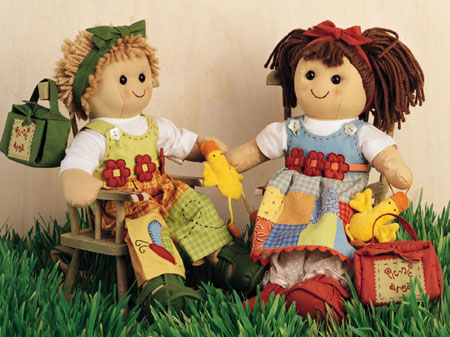
Picture 2
The doll on the left wears overalls. The flower pattern on the bottom end of the right pant leg is completely handmade. First, we put the agglutinated lining on the back of three pieces of cloth altogether, and used an electric iron to iron the cloth onto a yellow base cloth, and then used a pencil to draw the two antenna of the snail, and used three different color threads, sewing the three pieces of cloth to the yellow base cloth according to the requirements. The stitch was no longer than 0.5 centimeter, and the distance between two stitches was around 0.5 centimeters; the stitches had to be symmetrical and the stitch-lengths had to be the same. The antenna was embroidered with a coffee-colored piece of thread clipped to a pin. The bottom end of the left pant leg also followed the same requirements. It had to be in the shape of a curve and could not look rigid. We also embroidered a line around the collar of the overalls with 0.5 centimeters between stitches. The doll on the right had its collar embroidered on the same way.

Picture 3
Who would imagine that not only are the dolls in the hands of these cute young girls products of slave labor, but so are the hats and pants the girls are wearing.
In Picture 1, the flower on the right pant-leg of the girl on the left was embroidered by hand, stitch by stitch. The requirement was that the thread had to be invisible; the edges could not be rough; the flower could not be oblique and had to be smooth. The labor camp was only responsible for embroidering the flower; the pants themselves were manufactured elsewhere.
The hats worn by both girls and the flowers on them were also made at the labor camp. A circular line was embroidered onto the hat, and the line could not get inside of the hat lining.
The little house with a chimney pictured on the carpeting was also partially made in the labor camp and consisted of seven pieces of cloth. Every piece of cloth was embroidered to the bottom cloth according to their sequence.
The flower and little house on the dresses worn by the girls were also embroidered at the labor camp.
The packaging process of the dolls the girls are holding was as follows: first we put the pants on the doll, making sure the tag was in back. We put a dress, an apron and shoes on the doll. We cut off the thread and combed the ponytails. We put the hat on the doll and put it in a white cloth sack, put a drying agent under the doll's buttocks, then wrapped it in a transparent plastic bag, folded the paper box and put the fully packaged doll in the paper box. Each person was assigned to package 120 dolls a day.

Picture 4
The strawberry bag in front of the girl's feet was made at the labor camp. Both sides of the bag were embroidered with lines. After completion, it was diamond-shaped with a three-dimensional feel to it. The lines could not curve and the stitches had to be even and smooth.
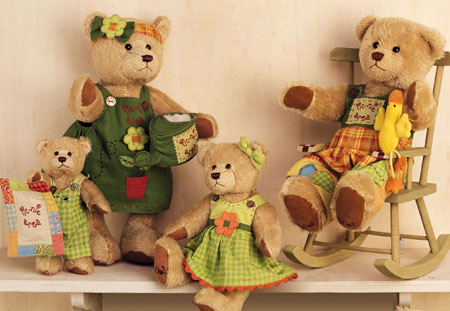
Picture 5
The pants and the flower pattern on the right pant-leg of the toy bear sitting on the chair were also partially made in the labor camp.
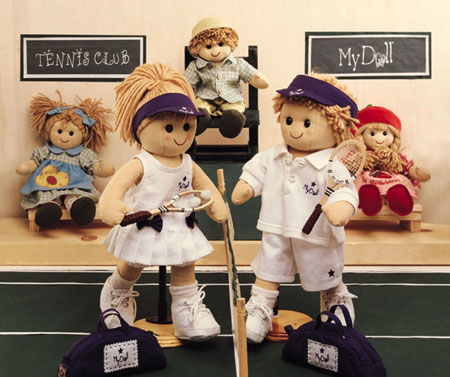
Picture 6
The sunflower on the dress of the doll on the rear left was embroidered on. A line was sewn onto the bottom of the apron and the collar. It was required that the stitches be even and that no more than a 0.5-centimeter gap existed between stitches. The connecting stitches and threads should be invisible. The head flower was also made in the labor camp.
The packaging process was as follows: we put the pants on the doll. We positioned the pants so the doll's legs were not exposed; we put shoes with white socks on the doll's feet, we folded the socks twice down and put the dress on the doll, affixed the head flower on the doll and wrapped it around its head two times. We cut the threads and combed the hair. We put the hat on the doll and put it in a white cloth sack, put drying agent under the doll's buttocks, then wrapped it in a transparent plastic bag, folded the paper box and put the fully packaged doll in the paper box. Each person was assigned to package 120 dolls a day.
The rubber band used to fix the head flower onto the doll's head was very tight and we had to wrap it around twice. After one day's work, our thumbs and index fingers were red and swollen. Nevertheless, we had to continue our work the next day, until the skin on our fingers broke open and bled.
Picture 7
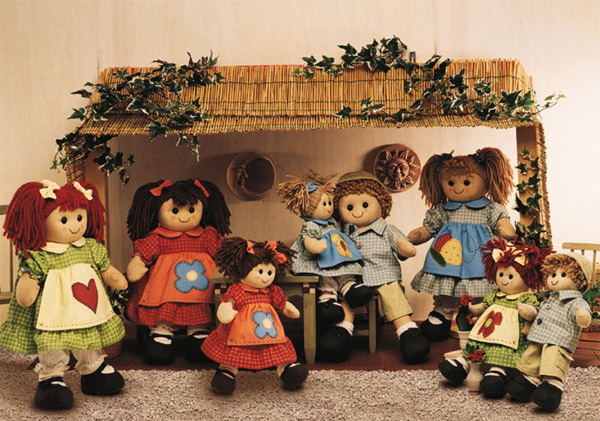
The flower patterns on the doll dresses in this picture were all embroidered at the labor camp. One line was embroidered smoothly on the collar and the bottom of the apron, with a space of 0.5 centimeters between stitches. The packaging process and amount of work is the same as in picture 6.
|
|
|
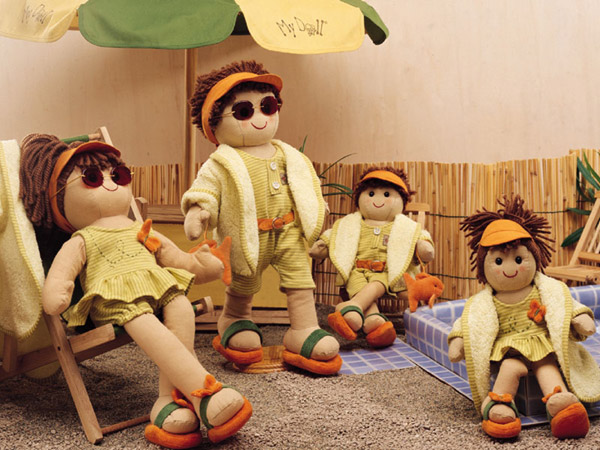
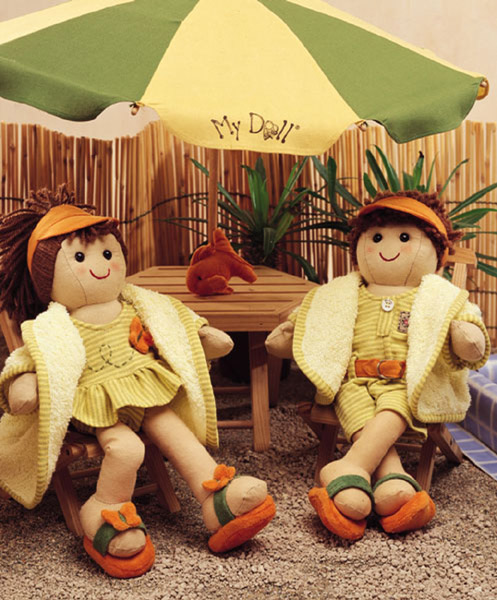
The butterflies and their wake [the trail by which the butterfly flew] on the dolls' clothes were done at the labor camp. It was required that the line along which the butterflies were stapled be invisible and the butterflies' traces must be even and smooth, with no rigid corner or lines.
Picture 10
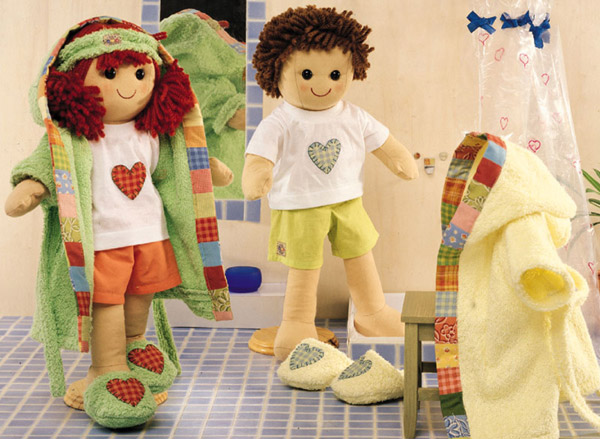
The packaging process for this doll was the same as the doll in picture one.
The photos published on this website only show some of the products we were forced to make at the labor camp. We were also assigned to work on the single-packed clothing, backpacks, and other accessories that went along with the dolls.
Chinese version available at http://www.minghui.org/mh/articles/2004/6/18/77245.html